Perspectives
- One thing that’s tough to follow in Smil is the narrowing and broading of the scope. One has to see the ‘technical’ details of energy and it’s impacts as well as the broader first principles of energy and it’s constraints on the world.
Assumptions
- Any Populations goal is to reproduce. This is the main metric that is being ‘tracked’.
- The human metabolic system is an ‘engine’ or energy converter like any other.
- Output is a function of land, capital, labour and technology.
- A conversion process can be optimised, it’s limitations can be altered.
- The system of interest, on a macro level, is the sun and the Earth.
- Growth of technologies follows an S-Curve. The limiting factor is put in by energy.
Questions
Meadows says in her book to use data, graphs through time to analyse the flow in a system. The system in our case is a mutating one constantly dictated by stock of energy and by the flow of power. The rate of energy expenditure.
- How might we develop something we can test?
- What role does technology play in the carrying capacity of a population?
- What is the system being analysed?
Energy is a fundamental property of the universe
In Science, to model the world, things to be examined are broken down into systems. A ball and the Earth is a system, the universe can be a system. The idea is that at some point you have the things you’re interested in and those that you’re not. It’s the spherical cow notion. For a system we define a measure of that system called Energy. This is a numerical value that’s a property of the system.
Energy is transferred between systems and there is a symmetry to the transfer. If I lose heat, my surroundings gains that heat. This does not apply on the scale of the system of all systems i.e. the universe due to relativity and other shit. We’re left with this quantity that can’t be created or destroyed just transferred about the place.
Chapter 1
Energy is the only universal currency: one of its many forms must be transformed to get anything done.
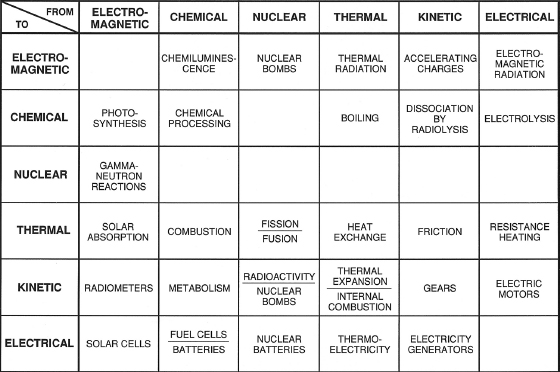
A taxonomy of energy types might be the start of the physical intuition for energy. > All known forms of energy are critical for human existence
Smil states that matter is energy at rest, which doesn’t really offer insight. He takes the viewpoint of stocks and flows of energy. That understanding “stores”, “potentials” and “transformations” was established in the 19th century.
Creating our own conversions and flows of energy
What really stuck out to me in this chapter was the idea of conversions. What makes humans special is our ability to make our own converters. All animals got one from evolution (the metabolism) and we’ve been able to make our own (like steam engines).
Smil states that the metabolism inherentely limits the kinetic energy of working muscles. This makes sense if thought of as a work engine with some efficiency. The conversion process of our metabolism has some finite performance (efficiency).
Animate metabolism reorganizes nutrients into growing tissues and maintains bodily functions and constant temperature in all higher species. Digestion also generates the mechanical (kinetic) energy of working muscles. In their energy conversions, animals are inherently limited by the size of their bodies and by the availability of accessible nutrition. A fundamental distinguishing characteristic of our species has been the extension of these physical limits through a more efficient use of muscles and through the harnessing of energies outside our own bodies.
Humans have been the only animal to really go beyond this with tool use and brain power to access extra somatic forms of energy.
- Important here is the processes involved in accessing these extrasomatic energies. For instance, the harness was an artifact that was used to do this. In some cases, like irrigation its reliant on information flow to organise large structures.
- Smil extends this to more modern ideas of things conductive to basic research like education, legal arrangements, access to capital and basic economic rules. This sense of reliability and foundation allowed the creation of knowledge to tap into extrasomatic energies.
- He uses a flow analogy for human ingenuity and that the above can be seen as valves to open these flows.
Basic definitions, units and some napkin calculations we can do with them
Power density the rate at which energy is produced or consumed per unit area. For an 18th century city that required fuel for making goods, cooking and heating it required about 20 - 30 W/m^2. Even really fast growing fuel wood could not match this power density unless it’s area was massive. ??? Needs more work.
Energy density is easy to intuit. An energy dense bar vs some carrot sticks on a hike, or the energy density of a fuel, how much work can be extracted from a given volume.
Example: Coal plant capacity
https://www.vaclavsmil.com/wp-content/uploads/docs/smil-article-power-density-primer.pdf
The net capacity factor is the unitless ratio of actual electrical energy output over a given period of time to the theoretical maximum electrical energy output over that period.
- Assume 1GW capacity with no overhead of sourcing the coal.
- Burning coal of energy density 20GJ/t.
- With a capacity factor of 80%.
- Conversion efficiency of 38%.
- How much electricity would this produce in a year? 7TWh
- How much coal energy do you need? 7TW * 60*60 = 2.5e16 which is 25PJ. But then, 25/0.38 = 65 PJ!
- How much coal would it need?
- Using a 15m deep seam and the coal is 1.4t/m3, then per m3 you’ve 20t of coal.
- 400GJ per m2 of surface area.
- 65PJ/400GJ which is 162,500 m2 of land. About 16 ha.
Actual numbers for America’s largest coal-fired electricity generating plant, Robert W. Scherer in Georgia with installed capacity of about 3.5 GW, indicate the actual claims: coal storage yard of 36 ha, and an ash-settling pond of 120 ha (designed to last for the plant’s lifespan of some 50 years) with the plant’s total operating area covering about 1,400 ha (all data from Georgia Power).
Why is power density - which in the above example says that to provide 800MW of power requires 16ha of land a year giving it a land ‘density’ of 800e6/162500 = 4923 W/m2. Detailing how much power we extract from a m2 of land in the best case- a useful measure. It’s a power to land ratio, how efficient our land use is. The higher this ratio the more power we extract per m2 of land.
Does this measure give a sense of the land area we can support too?
Chapter 2
- We’ve spent most of our development as foragers, similar to primates but “we now have isotopic evidence from East Africa that by about 3.5 million years ago hominin diets began to diverge from those of extant apes.”
- C4 cultivars?
- About 7 million years ago bipedalism developed
Humans are the only mammals whose normal way of locomotion is walking upright (other primates do so only occasionally), and hence bipedalism can be seen as the critical breakthrough adaptation that made us eventually human.
- Smil says that bipedalism started a cascade of
adjustments
- Freeing our upper body to develop language and to aid in the progress of tool use (through greater leverage with items like a spear).
Food storage to socialization to agriculture
A food supply dependent on a few seasonal energy flows required extensive, and often elaborate, storage. Storage practices included caching in permafrost; drying and smoking of seafood, berries, and meats; storing of seeds and roots; preservation in oil; and the making of sausages, nut-meal cakes, and flours. Large-scale, long-term food storage changed foragers’ attitudes toward time, work, and nature and helped stabilize populations at higher densities. The need to plan and budget time was perhaps the most important evolutionary benefit. This new mode of existence precluded frequent mobility and introduced a different way of subsistence based on surplus accumulation. The process was self-amplifying: the quest for the manipulation of an ever larger share of solar energy flows set the societies on the road toward higher complexity.
Chapter 3
the evolution of agriculture can be seen as a continuing effort to raise land productivity (to increase digestible energy yield). p.49.
On the transition from foraging to farming.
Smil’s inspiration is that of
Boserup (1965, 1976) conceptualized the link between food energy and the evolution of peasant societies as a matter of choices.
These choices are once an agricultural system (land, community, no of workers etc.) reaches the limits of its productivity, people can:
- Migrate.
- Stay (and stabilize numbers).
- Stay (and let their numbers decline).
- Adopt more productive form of farming.
The last option seems like a no brainer but required large energy inputs.
Increased productivity will support larger populations by cultivating the same (or even smaller) areas, but the net energy return of intensified cropping may not increase and may actually decline
To get more out the land, you had to put more in (work). This might not pay off.
According to Smil, everywhere in the world was slow to advance productivity of the land they had. > everywhere, it took millennia to shift from regular, extensive fallowing to annual cropping and > then to multicropping.
Carolingian Europe were overpopulated and their grain supplies were chronically inadequate, but only in parts of Germany and Flanders were new fields created in less easily cultivable areas
Where the marginal cost to cut cropland was high, farming intensification increased.
Farming Intensification
Farming wasn’t necessarily immediately energy efficient so the energy explanation doesn’t offer much in the explanation of this transition. It does offer an explanation for the increase in population after the transition though with increases in population.
We can use this as a stepping stone into Smil’s world though. His core thesis is that of farming intensification. This is something that led to more energy being stored on Earth and was driven by an increase in labour and capital.
Historically, societies tried to develop ways to get more out of the land they had. There were three core features to this, common across the world:
- An increased use of animal labour.
- A focus on irrigation and fertilization systems.
- Multi cropping and crop rotation.
It’s important to establish the commonalities across societies as it can give a sense of the core problems faced. There are 5 main steps to developing crops on a fixed land area.
- Ploughing: Fundamental to agriculture. The ancient Greeks and Romans used a symmetrical plow but the Han Dynasty era China developed the first Moldboard plough. With thicker soil in Europe a plow with a shaper point and a surface (plough share) to turn the soil to the side was developed.
- Harrowing and leveling the ploughed ground.
- Seeding, which was done using a seed drill in the Mesopotamia since ~1300BCE but was still done with broadcast seeding by hand in Europe until the 19th century (this method is inefficient with large amounts of seeds not planted properly).
- Harvesting: The first tool being the sickle, that replaced basic stone tooling.
- Processing: Like milling the grain by hand or with animal labour or pressing of oil.
Another trend in all cultures was a dominance of a cereal grain. The particular cereal depending on geography but in hindsight, grains seem like a solid foundation as opposed to tubers or legumes because:
- The water content of tubers is too high for long term storage and requires large storage volumes.
- Tubers have low protein. Legumes have high protein but low yields. Average yields for US cereals is 7.3T/ha in 2013 vs 2.5T/ha for legumes.
- Fairly high yields, good nutritional value, relatively (as much as 5 times tubers) high energy density at harvest and easier to store.
- Particular species dominating depended on environmental conditions.
Animal Labour
Draft potential could only be translated into useful work through a harness. He discusses the tension between harnessing the horses power for the tasks farmers wanted it to do.
Irrigation
p.76 total seasonal need of water is approximately 1,000 times the mass of the crop e.g. 1,500t of water are needed to grow one tonne of wheat.
The energy cost of human-powered irrigation was extraordinarily high. A worker could cut a hectare of wheat with a cradle scythe in eight hours, but he would need three months (8 h/day) to lift half of its water requirement just 1 m from an adjoining canal or stream.
Fertilization
It’s useful here to highlight the back of the envelope calculation Smil has showing the marginal increase in yield or the leverage of labour with nitrogen.
A good late Qing dynasty winter wheat harvest of about : * 1.5 t/ha * required just over 300 hours of human and about 250 hours of animal labor. * Fertilization took, respectively, 17% and 40% of these totals. * Fertilization hours are 51 and 100 hours. * 10 t/ha of fertilizer which contains 0.5% nitrogen. * Due to leaching only half that nitrogen becomes available. * 25 kg/ha nitrogen for crops. * Each kg will add 10kg of grain. So 2510 = 250kg of extra grain. 3% used then as animal feed. * I think what Smil is saying is that you get 200kg of flour (2.8GJ) for 51 hours of extra work (40MJ) of energy.
Constancy and change
In most regions traditional farming progressed from extensive to intensive cultivation: its prime movers—human and animal muscles—remained unchanged for millennia, but cropping practices, cultivated varieties, and the organization of labor were greatly transformed. Thus both constancy and change mark the history of traditional farming.
Where extensive refers to the use of labour and capital over a large land area and intensive is the same over a smaller land area.
- Extensive farming: System of crop cultivation using small amounts of labour and capital in relation to area of land being farmed.
- Intensive farming: System of cultivation using large amounts of labour and capital relative to land area.
“Because extensive agriculture produces a lower yield per unit of land, its use commercially requires large quantities of land in order to be profitable. This demand for land means that extensive agriculture must be carried on where land values are low in relation to labour and capital, which in turn means that extensive agriculture is practiced where population densities are low and thus usually at some distance from primary markets.” How Asia Works? [^1]
Claim: Farming became more intensive
What data would we expect to see for this claim? There seems to be evidence due to increase in methane emissions in ancient societies and population increases. This along with the development of more advanced tools and use of tools (scaling up labour and capital inputs).
Case Study for the more extensive approach: Egypt
Emmer wheat and two-row barley were the first cereals, and sheep (Ovis aries) were the first domesticated animals.
It seems that Egypt due to geography took a more extensive approach. Specifically, they did not develop the irrigation systems of China as the Nile banks had low gradient.
Case Study on large organisation : China
The largest and longest lasting contribution to the agricultural system in China was irrigation. Sichuan’s Dujiangyan still supports 10 million people to this day.
The construction and unceasing maintenance of such irrigation projects (as well as the building and dredging of lengthy ship canals) required long-range planning, the massive mobilization of labor, and major capital investment. None of these requirements could be met without an effective central authority. There was clearly a synergistic relationship between China’s impressive large-scale water projects and the rise, perfection, and perpetuation of the country’s hierarchical bureaucracies.
- Large waste recycling coordination admired by the west. “at least 10% of all labor in Chinese traditional farming was devoted to managing fertilizers”
Even in the early 20th century China was getting large yields on farming largely due to minimal mechanization, human labour dominating.
Human and animal labour as the prime mover just could not sustain a reliable food supply. Why?
The environment tells you when you work
The shift from foraging to farming left a clear physical record in our bones. Examination of skeletal remains from nearly 2,000 individuals in Europe whose lives spanned 33,000 years, from the Upper Paleolithic to the twentieth century, revealed a decrease in the bending strength of leg bones as the population shifted to an increasingly sedentary lifestyle (Ruff et al. 2015).
Smil uses about 800kJ/h for a rate of work and 15GJ/t for cereal that could be stored. Farming wasn’t always really intensive work. But in a sense, it couldn’t really be or else no one would have scaled the mountain of work for it to become stable. What it did include was a life determined by the seasons.
The Intensification feedback logic
Whether theres a harvest depends on water, how big it is depends on fertilizer - Chinese peasant
More draft animals (1) fueled more fertilization (2) and in some places aided in irrigation systems (2). More powerful prime movers and water supply also increased the yields from multicropping and crop rotation (3). All these combined to be able to support not just more people, but more animals which starts the cycle again.
Chapter 4
Smil’s opening paints this picture of an inconsistent progress of humans
inconsistent food surpluses that they [societies] produced with the aid of a few simple tools and the exertion of their muscles and the draft of their animals sufficed to support the unevenly advancing complexity of urban societies.
- There are a number of achievements in this period though with regards to energy output: the pyramids, baroque churches, increased transportation infrastructure and metallurgy advances.
- This is a similar point made with farming of ‘Constancy and Change’.
- This period is about utilising animate movers in the most efficient way possible which involved 1) better organisation of the application of animate power (pulleys, levers etc.) and 2) Technological innovation (new energy conversion or increasing efficiencies of established processes). What’s the difference between these two?
- Figure 4.1 shows an example of the progression of a water wheel in the sense of increasing technical knowledge.
Chapter Summary according to Smil
- First appraise the kinds, capacities, and limits of all traditional prime movers (human and animal muscles, wind, water) as the combustion of phytomass fuels, mostly wood and charcoal made from it (or crops where regions deforested).
- Next, Look in some detail at the uses of prime movers and fuels in critical segments of traditional economies (food preparation, provision of heat and light, transportation, construction, and in color and ferrous metallurgy.
Animate Power and Simple Machines
What does a purely animate energy world look like, what are its limitations?
- Societies that derived any kinetic energy from animate power could not provide reliable food supply or material wealth consistently to its inhabitants (think, medieval Europe). Power applied is driven by metabolic requirements.