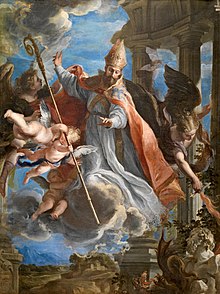
His speculative views are influenced out of necessity by the scriptures
Unlike origen where platonism and Christianity lay side by side
Thoughts on time and its three types in a subjective sense. Shows a high level of thinking
CIty of God written as a counter argument to the power vacuum after the fall of Rome
(?)
Russell highlights the broad contrasts between the city of this world and the city of god
Damnation. Our ancestors sinned therefore we all die.
Quote The punishment of all mankind for Adam’s sin was just; for, as a result of this
sin, man, that might have been spiritual in body, became carnal in mind
The need for lust in sexual intercourse is punishment for adams sin
Virtue relies on complete control of the will
This sense of judgement eternal by God.
This thought led to the subjugation of the western states to the Church ? This along
with the assimilation of the new state after the fall of Rome to Christian ideology
espoused by St Augustine
Interesting table by Russell comparing emotional content in relation to Eschatology
from Marx.
5th and 6th centuries
Only form of centralisation became the Church
St. Cyril vs Nestorius about the nature of Christ. The later maintaining that there were two
persons in Christ, one human and one divine.
Boethius Consolations of Philosophy, interesting for the time period. Should looke into
more
Gregory the great and monasticism from St Benedict which apparentely extended all over the western
world except Ireland ?
Pope Gregory Jose de Ribera
P.365 reasons as the rise of the Popes power in the West
Combined imperial tradition of Rome with legends of martyrdom of Peter and Paul
Emperors in the Holy Roman Empire only became emperors when crowned by the Pope
After Charlemagne English monasteries were centered around by new civilizations that were starting
in England.
The dark ages were not world wide. From 600-1000 AD Western Europe was in the dark ages, but not
the rest of the world. A lot of scientific progress comes from the East, built on structures from
the West developed in the Dark Ages ?
John the Scot “most astonishing person of the ninth century”
Ireland as a refuge for culture in the 6th, 7th and 8th century
p.378 Johns writings on Platonic ideas On the Division of Nature
Frederick made a peaceful conquest of Jerusalem which pissed of the Pope at the time who
wanted a crusade.
Herectics in the 13th century. “The cause of wide diffusion of heresy was partly
disappointment at the failure of the Crusades, but mainly moral disgust and the wealth and
wickedness of the clergy”
Details several heretic groups
The church in the early 13th century was in danger of revolt, saved in large part by the rise
of mendicant orders.
Founding of Dominican and Franciscan orders. Following thought leaders were part of this order
St Thomas Aquinas
His thoughts became the accepted philosophical thoughts of the Church
Should look into his proofs on God, unmoved mover p.420
Very confused. Gods will is his essence
So the essence of God or divine providence dictates all. How do we possibly contribute to it?
does evil affect it?
”By mortal sin a man forfeits his last end to all eternity, and therefore eternal punishment
is his due"
"Man needs grace to persevere in good, but no one can merit divine assistance”
No reason can be attained as to who is elected and go to heaven. Baptism is needed though, in
according with the scriptures.
Heavily influenced by Aristotle
”Before he begins to philosophise, he already knows he truth” not true philosophy
Just in reading accounts of the thoughts of different Franciscan schoolmen all there influences
are like tributaries or something, Aristotle mixed with plato mixed with plagiarism it makes sense
but just interesting to see
’principle of individution’ for two ‘things’ say, of the same species, can the be said to have
different essences if identical in a material sense. St thomas says that they are different in the
immaterial sense, not the material. Duns Scotus says that there are always differences. p.431 in a
more modern sense.
Character of opposition to the Pope changed at this time, becoming more democratic as opposed to
just siding with the emperor.
”Dante’s thought is interesting, not only in itself, but as that of a layman; but it was not
influential, and was hopelessly out of date.”
William of Occam if everything in some science can be interpreted without assuming this or that
hypothetical entity, theres is no grounds for assuming it.
Occam on logic interesting enough p.436 very confused
Asiatic religions taking over greek.
Details influences that led to Christianity really crazy, priesthood from the east, sacred
book from the Jews etc.
Christian philosophy was enriched by contact with Constantinople and the Mohammedans Aristotle
came to be known in the west
Very confused by history of the schism, start of Protestantism and Wycliffe, start of the modern
world.
Can define it as the time when the state started to define culture as opposed to the church
Enter a new authority, science, both its theoreticla and practical aspects. The practical
importance first recognised in connection with war.
Quote The triumph of science has been mainly due to its practical utility, there has
been an attempt to divorce this aspect from that of theory, thus making science more and
more a technique, and less and less a doctrine as to the nature of the world.
Emancipation from the church led to the growth of individualism
Russell says that the renaissance in Italy around the time of Machiavelli had an anarchic
character, it wasn’t sustainable but the freedom of though is evident.
This intro should be reread p..450
Power conferred by science is social. “an average individual wrecked on a desert island could
have achieved more in the seventeenth century than he could now”
The power conferred by science is scattered. Its all about means as opposed to ends. This is
also a form of madness Russell says, like subjectiveness. It is a madness that needs a
philosophy russell says.
Italian Renaissance
Italy had just powerful states between the 13th and 15th century
Venice was mercantile, Florence really civilized. Ruled by the Medici’s late 15th century.
Seems like an interesting enough period.
Pope became more of a head of culture for Italy. Encouragement of humanism until the victory
of the counter reformation and Spain the Italian Renaissance ended.
The Renaissance broke down the scholastic system (the idea of a wrote philosophical model
?)
”The first effect of emancipation from the Church was not to make en think rationally, but to
open their minds to every sort of antique nonsense”
Interesting, he finishes the chapter talking about the instability of Italian society at the
time. “every stable system hitherto devised has hampered the development of exceptional
artistic o intellectual merit. How much murder and anarchy are we prepared to endure for the
sake of great achievements”
Spinoza
Interesting chapter.
Logical monism the idea that logical the universe is all one. But the refutation is
interesting. In that reasoning alone is not enough to determine the universe, to “successfully
infer” the future.
His idea on metaphysics is interesting and comes close to what I feel is Christian philosophy
Im familiar with. That are events or matters are part of a whole that stretches to the
beginning and end of time. That finite things are a result of negation, some form from the
void.
”The mind’s highest good is the knowledge of God, and the mind’s highest virtue is to know
God"
"The wise man, so far as human finitude allows, endeavours to see the world as God sees
it”
p.548 brief overview leading to Locke. The main thing I take away from it with my brief
knowledge is the idea of resolving to have checks on the monarchy, to put more power into the
nations hands while trying not to go back to the Cromwell style dictatorship knowing how
brutal a civil war was. Refers to Locke as the ‘apostle’ of Revolution of 1688 “the most
moderate and successful of all revolutions”
Trying to wrap my head around Leibniz
Quote “In the advanced countries, practice inspires theory; in the others, theory inspires
practice. This difference is on of the reasons why transplanted ideas are seldom so successful as
they were in their native soil”
The rise of separation of the executive and the judiciary, resistance of the Stuarts
Locke says that people should that force should be used to overthrow the unjust and unlawful. Who
defines this unjustness and unlawfulness? The party with the most power?
Locke’s principles of division of powers in their fullest application in the US.
Finishes with noting how different things are after the industrial revolution. We are no longer
talking about the individual as Locke speculated, its now about organisations. The division of
property is not as clear cut. That state of nature still exists between states.
I never realised the influence of Locke was so important. Russell details the differences in
empiricism and thought of the time. Its also interesting to note what philosophies are ‘taken up’
especially politically by states given current circumstance.
Russell gives a general map of liberalism. The hard headed and the soft hearted both leading
or developing into Stalin and Hitler respectively.
Quote The stages in the evolution of ideas have had almost the quality of the Hegelian
dialectic: doctrines have developed, by steps that each seem natural, into their
opposites. But the developments have not been due solely to the inherent movement of ideas;
they have governed, throughout, by external circumstances and the reflection of these
circumstances in human emotions.
Its interesting to try and be empathetic to the beliefs of the time. Russell says that Locke
accepted Descartes’ arguments for the existence of God, Berkeley invented a new argument but then
Hume rejected metaphysics entirely, and held that nothing can be discovered by reasoning on
subjects of metaphysics. Locke was game changing but still influenced by some beliefs of his time,
just interesting to see how that developed. Also, I think empiricism is a very common view. Its
one I have I think. It allows me to disregard metaphysics and general un-testable hypothesis. Was
Locke just like that too, was Descarte or any general way of viewing things like a brick wall of
thought?
Bergson introduces this new classification of philosophy for the ‘common’ man. Where action
and happiness are the ultimate good (utilitarianism ?) and knowledge just an instrument in
this system.
Evolution is creative, its wants can be predicted but what actually results is unpredictable